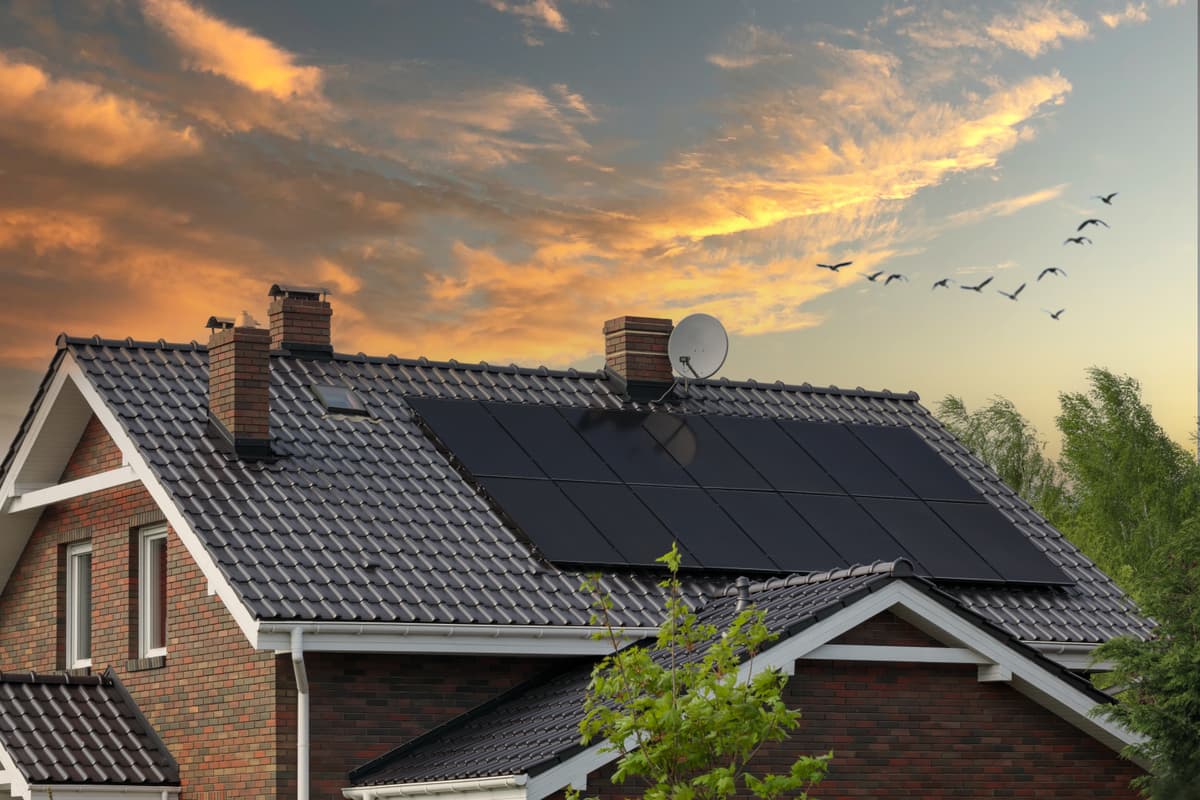

How Many Solar Panels Do I Need for My Home?
The short answer: Most California homes need 15-25 solar panels, covering 300-500 square feet of roof space. The exact number depends on your electricity usage, panel wattage, roof orientation, and whether you're planning for future needs like an EV. Here's how to calculate your specific requirements.
Quick Sizing Guide
| Monthly Electric Bill | System Size | Number of Panels* |
|---|---|---|
| $100-150 | 4-5 kW | 10-13 |
| $150-200 | 5-6 kW | 13-15 |
| $200-300 | 6-8 kW | 15-20 |
| $300-400 | 8-10 kW | 20-25 |
| $400-500 | 10-12 kW | 25-30 |
| $500-700 | 12-16 kW | 30-40 |
| $700+ | 16-20 kW | 40-50 |
*Based on 400W panels. Higher wattage panels = fewer needed.
The Three-Step Sizing Formula
Step 1: Determine Your Annual Electricity Usage
Option A: Check your utility bill Look for "Total kWh" or "Annual Usage." Add up 12 months.
Option B: Use your bill amount Divide your annual bill by your average rate:
- PG&E: Divide by $0.45
- SCE: Divide by $0.42
- SDG&E: Divide by $0.55
Example: $3,600/year ÷ $0.45 = 8,000 kWh annual usage
Step 2: Calculate System Size Needed
In California, 1 kW of solar produces approximately 1,400-1,600 kWh per year (varies by location and roof orientation).
Formula:
System Size (kW) = Annual Usage (kWh) ÷ 1,500
Example: 8,000 kWh ÷ 1,500 = 5.3 kW system
Step 3: Calculate Number of Panels
Divide system size by panel wattage:
| Panel Wattage | Panels for 5.3 kW |
|---|---|
| 350W | 15.2 → 16 panels |
| 400W | 13.3 → 14 panels |
| 450W | 11.8 → 12 panels |
Example result: A home using 8,000 kWh/year needs approximately 12-16 panels depending on panel wattage.
Factors That Affect Panel Count
1. Panel Wattage (Efficiency)
Modern panels range from 350W to 480W:
| Panel Type | Wattage | Panels for 8 kW |
|---|---|---|
| Standard | 350-370W | 22-23 |
| High-efficiency | 400-420W | 19-20 |
| Premium | 440-480W | 17-18 |
Higher wattage = fewer panels needed (but usually higher cost per panel)
2. Roof Orientation
Your roof's direction affects how much each panel produces:
| Orientation | Production | Panels Needed |
|---|---|---|
| South-facing | 100% | Baseline |
| Southwest | 95% | +5% more |
| West | 88% | +14% more |
| Southeast | 93% | +7% more |
| East | 85% | +18% more |
| North | 55-65% | +50%+ more (often impractical) |
Example: If you need 16 panels with south-facing, you'd need about 19 panels facing west.
3. Roof Pitch (Angle)
Optimal pitch in California is 15-35 degrees:
| Pitch | Impact |
|---|---|
| 15-35° | Optimal (100%) |
| 0° (flat) | 90-95% (tilt mounts help) |
| 35-45° | 95-98% |
| 45°+ | 90-95% |
Most roofs fall within acceptable ranges. Flat roofs use tilt mounts to optimize angle.
4. Shading
Trees, chimneys, and neighboring buildings reduce production:
| Shading Level | Production Loss | Extra Panels Needed |
|---|---|---|
| None | 0% | None |
| Minor (morning/evening only) | 5-10% | 1-2 |
| Moderate | 15-25% | 3-5 |
| Heavy | 30%+ | May be impractical |
Microinverters help mitigate shading—if one panel is shaded, others continue producing normally.
5. Future Usage Plans
Size for where you're going, not just where you are:
| Future Addition | Extra kWh/Year | Extra Panels |
|---|---|---|
| Electric vehicle | 3,000-4,500 | 6-10 |
| Heat pump (replacing gas) | 2,000-3,500 | 4-7 |
| Hot tub | 2,400-3,600 | 5-7 |
| Pool pump | 2,000-4,000 | 4-8 |
| Home office (full-time) | 500-1,000 | 1-2 |
| ADU/addition | 3,000-6,000 | 6-12 |
Pro tip: It's cheaper to install extra panels now than to expand later.
Roof Space Requirements
Space Per Panel:
- Standard panel: ~18 sq ft (roughly 3.5' × 5.5')
- Including spacing: ~21-22 sq ft per panel
Total Space Examples:
| System Size | Panels | Roof Space Needed |
|---|---|---|
| 5 kW | 12-14 | 250-310 sq ft |
| 8 kW | 18-22 | 380-490 sq ft |
| 10 kW | 23-27 | 490-600 sq ft |
| 12 kW | 28-32 | 590-710 sq ft |
Usable Roof Space:
Not all roof space is usable:
- Setback from edges: 3 feet typically required
- Around vents/skylights: 1-3 feet clearance
- Around HVAC equipment: Clearance required
- Fire pathways: Required in some jurisdictions
Rule of thumb: About 60-70% of total roof area is typically usable for solar.
Don't Have Enough Roof Space?
Options if roof space is limited:
- Higher efficiency panels (more watts per sq ft)
- Ground-mounted system (if yard space available)
- Carport/patio cover mount
- Partial offset (cover most of usage, not all)
Panel Count by Home Size
While usage matters more than square footage, here are typical ranges:
| Home Size | Typical Usage | Panel Count |
|---|---|---|
| 1,000-1,500 sq ft | 4,000-7,000 kWh | 8-15 |
| 1,500-2,000 sq ft | 6,000-9,000 kWh | 12-20 |
| 2,000-2,500 sq ft | 8,000-12,000 kWh | 16-26 |
| 2,500-3,000 sq ft | 10,000-15,000 kWh | 20-32 |
| 3,000-4,000 sq ft | 12,000-20,000 kWh | 24-42 |
| 4,000+ sq ft | 15,000-30,000 kWh | 32-60+ |
Warning: Square footage is a rough guide. A 2,000 sq ft home with a pool and EV uses far more than a similar home without.
NEM 3.0 Sizing Considerations
Under California's NEM 3.0, system sizing strategy has evolved:
Old Approach (NEM 2.0):
Oversize slightly → Export excess → Receive near-retail credits
New Approach (NEM 3.0):
Right-size for self-consumption → Add battery → Minimize exports
Practical Impact:
| Scenario | NEM 2.0 Approach | NEM 3.0 Approach |
|---|---|---|
| 8,000 kWh usage | 6-6.5 kW system | 5.5-6 kW + battery |
| Goal | 110% offset | 100% offset + storage |
| Export strategy | Maximize credits | Minimize exports |
Result: You might need slightly fewer panels under NEM 3.0, but you'll add battery storage.
Real-World Examples
Example 1: Small Efficient Home
Profile:
- 1,400 sq ft townhome
- $180/month electric bill
- South-facing roof
- No EV planned
Calculation:
- Annual usage: ~5,100 kWh
- System size: 5,100 ÷ 1,500 = 3.4 kW
- With buffer: 4 kW
- Panels needed: 10-11 (at 380W)
Example 2: Typical Family Home
Profile:
- 2,200 sq ft home
- $320/month electric bill
- Southwest-facing roof
- EV purchase planned next year
Calculation:
- Current annual usage: ~8,500 kWh
- Future EV usage: +3,500 kWh
- Total: 12,000 kWh
- System size: 12,000 ÷ 1,500 = 8 kW
- Orientation adjustment (+5%): 8.4 kW
- Panels needed: 20-22 (at 400W)
Example 3: Large Home with Pool
Profile:
- 3,500 sq ft home
- $580/month electric bill
- West-facing roof (primary)
- Pool pump, hot tub, two EVs planned
Calculation:
- Current annual usage: ~14,000 kWh
- Future EVs: +7,000 kWh
- Total: 21,000 kWh
- System size: 21,000 ÷ 1,500 = 14 kW
- Orientation adjustment (+14%): 16 kW
- Panels needed: 36-40 (at 420W)
What Size Panels Should You Choose?
Standard Panels (350-370W)
- Cost: Lower per panel
- Space: More panels needed
- Best for: Large roofs, budget-conscious
High-Efficiency (400-420W)
- Cost: Moderate
- Space: Good balance
- Best for: Most installations
Premium (440-480W)
- Cost: Higher per panel
- Space: Fewest panels needed
- Best for: Limited roof space, aesthetics priority
Our recommendation: 400-420W panels offer the best balance of efficiency, cost, and availability.
Key Takeaways
- Most California homes need 15-25 panels
- Your electric bill is the best sizing indicator—not home size
- Formula: Annual kWh ÷ 1,500 = System size in kW
- Plan for future needs (EV, heat pump) to avoid expansion costs
- Higher wattage panels reduce count but cost more per panel
- NEM 3.0 favors right-sized systems with battery storage
Frequently Asked Questions
How many panels to completely eliminate my bill?
Enough to produce your annual usage. Use the formula: Annual kWh ÷ 1,500 = kW needed. Divide kW by panel wattage for count.
Can I add more panels later?
Yes, but it's more expensive. Adding panels requires new permits, potential inverter upgrade, and separate labor costs. Better to size correctly upfront.
What if my roof can't fit enough panels?
Options: higher-efficiency panels, ground mount, carport mount, or partial offset (covering 70-80% of usage still provides significant savings).
Do all my panels need to face the same direction?
No. Modern systems with microinverters or optimizers can handle multiple roof faces efficiently. Your installer will design for optimal production.
How many panels do I need for a Tesla/EV?
Roughly 6-10 additional panels (2.5-4 kW) depending on your driving. Average EV adds 3,000-4,500 kWh/year.
Do panel counts include a battery?
No. Batteries store energy but don't produce it. Panel count is determined by energy needs; battery size is determined by storage needs.
Get Your Custom Panel Count
Online calculators give rough estimates. For an accurate count, you need professional analysis of:
- Your actual usage patterns
- Your specific roof (satellite imagery assessment)
- Local production factors
- Your future plans
Get a free design consultation:
- Precise panel count for your home
- 3D roof layout preview
- Production estimates
- Cost and savings projections
[Get Your Free Design] | [Calculate My System Size]
Silva Bros Solar: Right-sized systems for California families.